
TL;DR

Get home appliances delivered free — and shop member deals
- Fast, free delivery on millions of items
- Access to Prime Big Deal Days deals on October 6–7
- Prime Video, Amazon Music and more included
Researchers from India have simulated a new home cooling panel that combines photovoltaic power, thermoelectric cooling, and waste cooking oil as a phase change material. The system can deliver up to 15 kWh/day of cooling and has a potential payback period of around 3-4 years.
A team of researchers from India has developed a simulated model of a home cooling panel that integrates photovoltaic (PV) power generation, thermoelectric cooling, and waste cooking oil as a phase change material, demonstrating promising performance for sustainable indoor cooling.
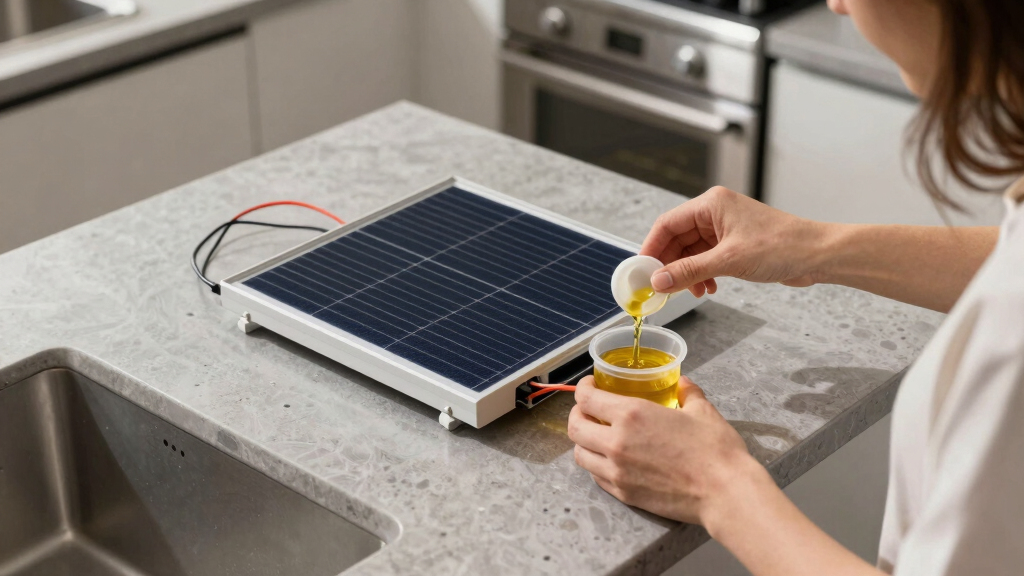
The cooling panel is designed with a PV module on the outer layer, converting sunlight into electricity. This electricity powers a thermoelectric (TE) module that is thermally coupled to a waste palm oil-based phase change material (PCM). During the day, the PV generates power to operate the TE module, which removes heat from the PCM, storing cooling capacity. At night, when solar energy is unavailable, the PCM releases stored heat, helping to lower indoor temperatures. The system was simulated using a multi-fidelity modeling framework, combining zero-dimensional and two-dimensional models, and trained with machine learning algorithms for optimization.
Results suggest that a single panel can provide approximately 6 to 15 kWh of cooling energy per day, reduce peak indoor temperatures by up to 3°C, and shift cooling loads by about three hours. A techno-economic analysis indicates a payback period between three and four years, potentially reduced to two with incentives. Additionally, a life cycle assessment shows the panel could avoid roughly 1.2 tons of CO₂ emissions annually, utilizing about 40 kilograms of waste cooking oil.
Potential Impact on Sustainable Indoor Cooling
This development offers a low-cost, environmentally friendly alternative to conventional cooling systems, utilizing waste cooking oil as a bio-based phase change material. The integration of PV and thermoelectric technology could significantly reduce energy consumption for cooling, especially in regions with abundant sunlight. The projected payback period and carbon savings highlight its potential for widespread adoption, particularly in areas seeking sustainable solutions to rising indoor temperatures and energy demands.
solar-powered thermoelectric cooling panel
As an affiliate, we earn on qualifying purchases.
As an affiliate, we earn on qualifying purchases.
Advances in Solar-Driven Cooling Technologies
Traditional home cooling methods rely heavily on electricity from fossil fuels, contributing to greenhouse gas emissions. Recent research has explored integrating renewable energy sources with thermal storage to improve efficiency. The use of phase change materials (PCMs) like waste cooking oil is gaining attention for their sustainability and low cost. Prior efforts have focused on PV-based cooling, but combining it with thermoelectric modules and bio-based PCMs represents a novel approach. The study from India builds on these developments, demonstrating a simulated model with promising performance metrics.
“The novelty lies in converting a waste resource into a low-cost thermal energy storage material for sustainable cooling applications.”
— an anonymous researcher
waste cooking oil phase change material
As an affiliate, we earn on qualifying purchases.
As an affiliate, we earn on qualifying purchases.
Long-Term Performance and Real-World Testing
While the simulation results are promising, it is not yet clear how the system will perform under real climatic conditions over extended periods. Long-term durability of the PCM, efficiency of the thermoelectric modules, and practical manufacturing challenges remain to be tested in real-world settings.
PV thermoelectric cooling system
As an affiliate, we earn on qualifying purchases.
As an affiliate, we earn on qualifying purchases.
Scaling Up and Field Testing Plans
The researchers plan to investigate long-term performance through field trials and explore scalable manufacturing processes. Future work will also focus on AI-driven control systems and improving PCM formulations to enhance economic viability and sustainability. These steps are essential before potential commercial deployment.
sustainable indoor cooling devices
As an affiliate, we earn on qualifying purchases.
As an affiliate, we earn on qualifying purchases.
Key Questions
How does the cooling panel work?
The panel uses solar energy to generate electricity via a PV module, which powers a thermoelectric device that cools a waste cooking oil-based phase change material, storing cooling capacity for daytime and nighttime use.
What are the environmental benefits?
The system reuses waste cooking oil, reducing waste and utilizing a bio-based PCM, while the solar-powered operation lowers greenhouse gas emissions associated with conventional cooling.
Is this technology ready for commercial use?
The current research is based on simulations; real-world testing and scaling are still in progress. Further development is needed before commercial deployment.
What is the expected cost and payback period?
Initial estimates suggest a payback period of three to four years, potentially reduced to around two with incentives, depending on manufacturing costs and energy savings.
Can this system be used in different climates?
The system’s performance under various climatic conditions remains to be tested, but the researchers plan to evaluate its durability and efficiency in diverse environments.
Source: PV Magazine
Fall yard work Picks
leaf blowers
As an affiliate, we earn on qualifying purchases.