
TL;DR

Get home appliances delivered free with Prime
- Fast, free delivery on millions of items
- Prime Video, Amazon Music and more included
- Member-only deals all year
A Veranda report brings together art historian Susie Hodge and interior designer Cameron Jones on how artwork may influence feelings at home. They say color and visual qualities can affect mood, but responses depend heavily on personal experience and preference.
A Veranda report on art and emotion at home draws on art historian Susie Hodge and interior designer Cameron Jones to explain how artwork’s color and form may shape how people feel in a room. The experts also stress that responses are personal: a painting that calms one person may unsettle another, making individual preference central to choosing art for a home.
Hodge, author of How Art Can Change Your Life, says that viewing art a person finds pleasing can trigger a dopamine rush. She compares the intensity of a strong response to euphoric feelings associated with love. This is her explanation of an emotional experience, not a guarantee that a particular work will affect every viewer the same way.
Jones says she asks clients how they want to feel in a room before selecting artwork and other design elements. For spaces intended to feel restful, she points to greens, blues and neutral shades as possible choices; for a breakfast room meant to feel lively, she suggests sunny yellow. Art can introduce a focused burst of color without requiring strongly colored walls or furnishings, she says.
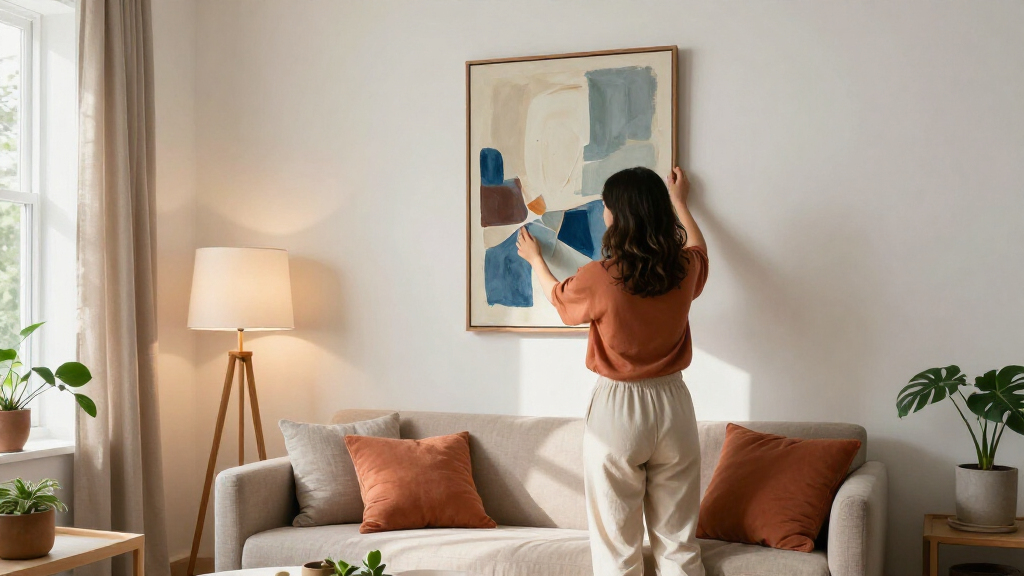
The report also describes how visual form may influence a viewer. Jones says clients often feel calmer around abstract works with rounded shapes and softer lines. Hodge similarly associates soft colors, smooth lines and horizontal forms with calm, while warning that sharp angles, jagged lines and bold patterns may energize some viewers and make others anxious or angry.
Choosing Art for Everyday Moods
Artwork is part of the environment people see every day, so choosing pieces with a room’s intended use in mind may help make a space feel more personal. The experts’ advice gives readers a practical starting point: consider whether a room should feel restful, lively or social, then notice how different colors and forms affect them.
The report does not present art as a clinical treatment or claim that a design choice will reliably change someone’s emotional state. Its central point is more modest: art can contribute to a room’s atmosphere, while the viewer’s memories, preferences and associations shape the reaction. That distinction matters for anyone trying to choose artwork for themselves or a shared home.
Products Worth Considering

Levoit EverestAir-P Smart Air Purifier for Large Rooms

Philips Hue White and Color Ambiance Smart Light Starter Kit, 2 A19 Bulbs with Hub

Levoit Vital 200S-P Smart Air Purifier for Large Rooms up to 1875 ft²
As an affiliate, we earn on qualifying purchases.
Color, Form and Personal Memory
The report situates its advice in both interior design and art history. Hodge cites Agnes Martin’s blue painting Night Sea, held by the San Francisco Museum of Modern Art, as an example of an artist seeking to encourage calm and positive thoughts. She also quotes Henri Matisse’s belief that colors could affect viewers, including his remark that “a certain blue enters your soul.” These examples describe artists’ intentions and views; they do not establish a uniform response among audiences.
Hodge also discusses Mark Rothko’s large, layered fields of color. Rothko said he aimed to express basic human emotions, and Hodge reports that some viewers cried in front of his paintings. The examples underline the report’s broader theme: art may prompt strong feelings, but those feelings are not identical for everyone.
Jones and Hodge both point to personal history as a factor. A work may evoke memories or associations that have little to do with its colors or style alone. Jones says this subjectivity makes art difficult to design around, but also helps make each home distinctive.
““When we see art that we find pleasing, it gives us a dopamine rush.””
— Susie Hodge, art historian and author of How Art Can Change Your Life
Why Reactions Differ Between Viewers
The source is an expert-based design report, not a controlled study comparing emotional responses to specific artworks. It does not provide measurements showing how often a color or form produces a particular feeling, or identify a single response that applies across viewers. Hodge and Jones describe observations and interpretations, while also acknowledging that individual reactions vary.
It is also unclear from the report how much a person’s reaction comes from the artwork itself versus memories, cultural associations, room lighting, or other features of the space. The source does not establish that choosing art can treat mental-health conditions or reliably alter mood. Its claims should be read as guidance for personal design choices, not medical advice.
Testing Choices in Your Space
The report offers no announced follow-up research or next formal milestone. For readers applying its advice, the practical next step is to pay attention to their own response: consider how a piece feels in the room where it will hang, and whether its colors and forms suit the room’s purpose. Because reactions differ, personal preference remains the clearest guide.
For shared spaces, household members may respond differently to the same work. Discussing what feels calming, energizing or distracting can help guide a choice without assuming that design rules work the same way for everyone.
Key Questions
Can artwork at home affect how people feel?
Hodge and Jones say artwork may contribute to a room’s emotional atmosphere. The source also stresses that reactions vary by person and does not claim art will produce the same effect for everyone.
Which art features may feel calming?
Jones points to abstract art with rounded shapes and softer lines. Hodge also associates soft colors, smooth lines and horizontal forms with calm, while noting that viewers can respond differently.
Does a particular color always create a particular mood?
No. The report gives examples of colors designers may use to support a room’s intended feeling, but it does not establish fixed effects. Personal associations and preferences can change how someone experiences a color.
Can choosing art treat anxiety or depression?
The report does not establish that artwork treats mental-health conditions. It discusses possible emotional responses and interior design choices, not clinical treatment.
Source: veranda.com