
TL;DR

Get home appliances delivered free with Prime
- Fast, free delivery on millions of items
- Prime Video, Amazon Music and more included
- Member-only deals all year
A House Beautiful report ahead of 2027 identifies five textile patterns that several interior designers say they are ready to use less: abstract brushstrokes, mass-market block prints, faux tapestry, ikat and oversized watercolor florals. The comments reflect the preferences of the designers interviewed, not a measured industry-wide shift.
Several interior designers interviewed by House Beautiful say they are ready to move away from five familiar textile patterns as 2027 approaches: abstract brushstrokes, mass-market block prints, faux tapestry, ikat and oversized watercolor florals. The report offers a snapshot of those designers’ preferences, rather than evidence that the patterns are falling out of favor across the industry.
The designers’ criticisms vary by pattern. Sara Swabb, founder of Storie Collective, says abstract brushstroke prints can feel forced when their contrasts are stark and their marks compete for attention. She prefers fabrics with subtle color shifts and slight irregularities, which she says can add depth and work well alongside other textiles.
For block prints, Sonia Chauhan, founder of Studio Sonia, distinguishes hand-stamped fabric from mass-produced versions. She describes traditional block printing as a process in which a maker repeatedly stamps fabric with a hand-carved block. The small variations left by that process are part of the appeal, she says, and are missing from mass printing.
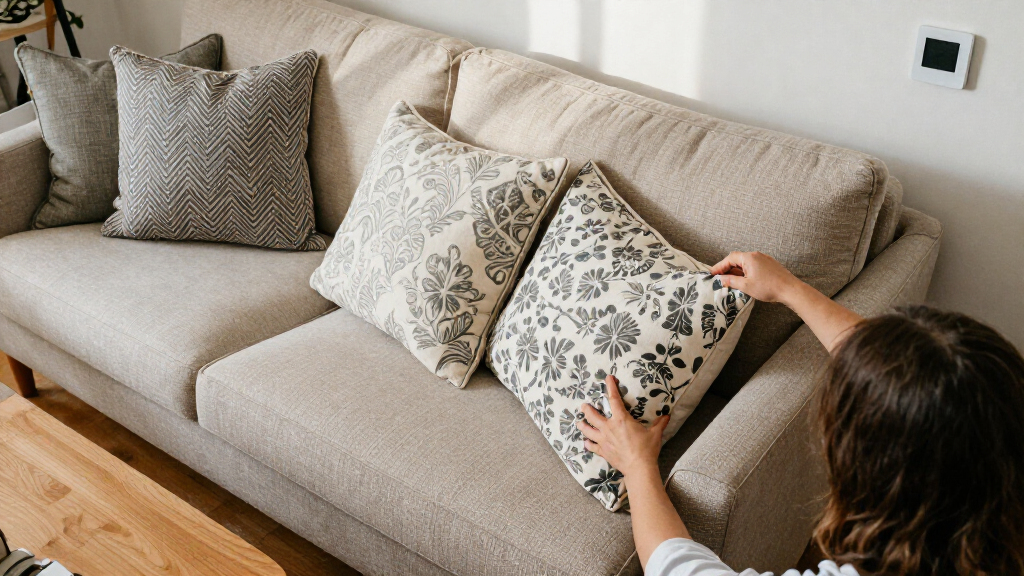
Designer Adnan Anwar says he prefers tapestries on walls rather than sofas and calls many tapestry-inspired prints derivative and overexposed. He allows that a tapestry-print pillow can work, but favors using an actual tapestry remnant for upholstery. Meghan Jay says ikat can be difficult to combine with other patterns and may add too much color or visual activity in a heavily layered room. Jay and Eve Jean, founder of Eve Jean Interiors, also say they are moving away from oversized, watercolor-style florals.
Why Designers Favor More Individual Prints
The report points to two recurring design preferences: more restrained combinations and textiles with visible detail or craftsmanship. Swabb favors nuanced color and irregularity; Chauhan values the evidence of handwork; and Jay prefers smaller, more defined botanical prints. These are recommendations from individual professionals, not formal rules for decorating.
For readers choosing fabric for upholstery, cushions or curtains, the comments offer a practical way to assess a print: consider its scale, contrast, production method and how it will sit alongside other colors and patterns in the room. A print described as dated by one designer may still suit a homeowner’s taste or a particular space. The story is less a declaration that the patterns are gone than a warning against relying on widely reproduced designs without considering their finish and context.
As an affiliate, we earn on qualifying purchases.
The Patterns Behind the Shift
House Beautiful frames the discussion as a look at patterns designers expect to use less as 2027 approaches, alongside renewed attention to upcoming color and design trends. The supplied report does not name a survey, sales data or a broader study supporting the idea that these prints have become less popular. Its evidence is the designers’ stated opinions.
The five categories also cover different issues. Abstract brushstrokes and watercolor florals draw criticism for their visual treatment; the objection to mass-market block prints centers on the difference between machine reproduction and handcraft; faux tapestry is challenged as an imitation and as an upholstery choice; and ikat is described as harder to layer. Jay’s suggested alternative for floral fans is a smaller-scale botanical with more defined detail.
““They bring depth to a room and mix beautifully with other fabrics.””
— Sara Swabb, founder of Storie Collective
As an affiliate, we earn on qualifying purchases.
How Broad the Pattern Shift Is
The report does not establish how widespread these preferences are among designers, retailers or homeowners. It gives no polling results, sales figures, dates for a measured change in demand or comparison with earlier years. The phrase “starting to look dated” reflects the views of the designers quoted, not a verified market trend.
It is also unclear whether the designers are responding to changes in client requests, their own creative preferences or both. The article does not say that any of the five patterns has disappeared from current collections, nor does it predict how quickly tastes may change. Readers should treat the list as professional opinion rather than a consensus or a rule about what belongs in a home.
As an affiliate, we earn on qualifying purchases.
What to Watch as 2027 Nears
House Beautiful presents the designers’ comments as guidance on what they plan to move away from leading up to 2027, but the supplied report gives no schedule for a follow-up or industry-wide forecast. A clearer picture of whether the preferences are spreading would require additional evidence, such as broader designer polling, retailer data or reporting on client requests.
For now, the concrete alternatives offered by the designers are specific rather than universal: choose hand-stamped block prints when craftsmanship matters, use tapestry fabric selectively, take care when layering ikat, and consider more defined, smaller-scale botanicals instead of oversized watercolor florals. Whether those choices become wider trends remains to be seen.
As an affiliate, we earn on qualifying purchases.
Key Questions
Which five textile patterns did the designers identify?
They named abstract brushstrokes, mass-market block prints, faux tapestry, ikat and oversized watercolor florals. The list reflects the views of designers interviewed by House Beautiful.
Does the report show that these patterns are falling out of favor industry-wide?
No. It reports designers’ opinions but provides no survey, sales data or other evidence establishing a broad change in demand.
What is the difference between hand-stamped and mass-produced block prints?
Designer Sonia Chauhan describes hand block printing as repeated stamping with a hand-carved block. She says the resulting small imperfections reflect the maker’s work and are not present in the same way in mass-printed fabric.
What floral prints does designer Meghan Jay prefer?
Jay says she is drawn to smaller-scale botanical prints with clearer detail, rather than oversized, watercolor-style florals.
Source: rss
Fall Picks
fall essentials
As an affiliate, we earn on qualifying purchases.