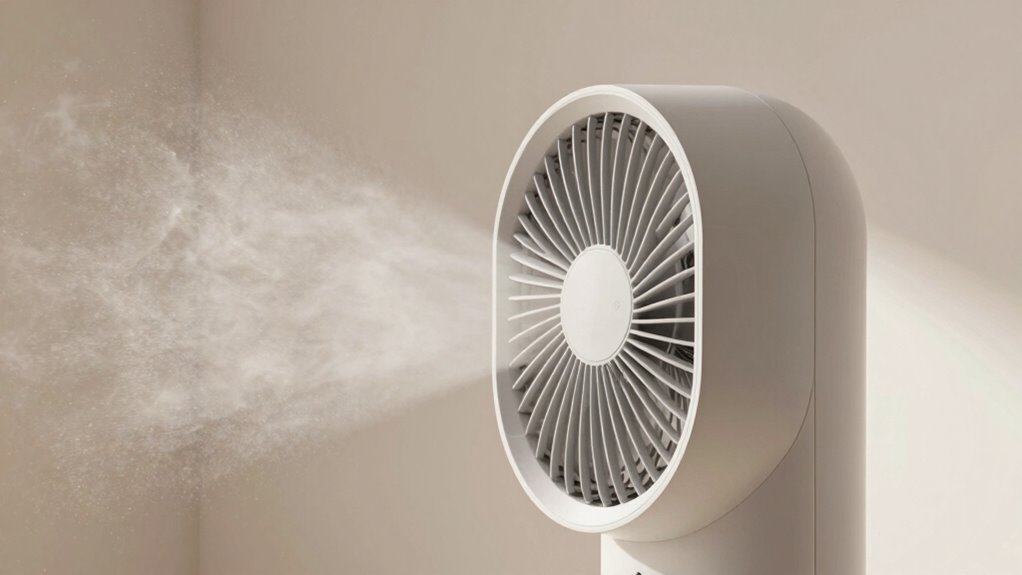

Bladeless fans seem quieter because their design creates a steady, low-frequency hum that’s less noticeable and less disruptive to your hearing. Unlike traditional fans that produce loud, mid- to high-frequency noises from spinning blades, bladeless fans push air smoothly through a hollow ring, reducing turbulence. This results in a calmer sound profile that many find less irritating, even if the cooling output is similar. If you want to understand more about how this works, keep exploring!

Get home appliances delivered free — and shop member deals
- Fast, free delivery on millions of items
- Access to Prime Big Deal Days deals on October 6–7
- Prime Video, Amazon Music and more included
Key Takeaways
- Bladeless fans produce a steady, low-frequency hum that is less intrusive than the broad-spectrum noise of traditional fans.
- The absence of blades reduces turbulence and mechanical vibrations, resulting in less disruptive noise despite similar cooling levels.
- Low-frequency sounds are perceived as less bothersome, making noise perception more favorable even if cooling output remains constant.
- Sound engineering in bladeless fans minimizes abrupt or sharp noises, enhancing perceived quietness over cooling performance.
- Individual sensitivity to high-frequency sounds influences how noise perception changes more than the actual cooling efficiency.
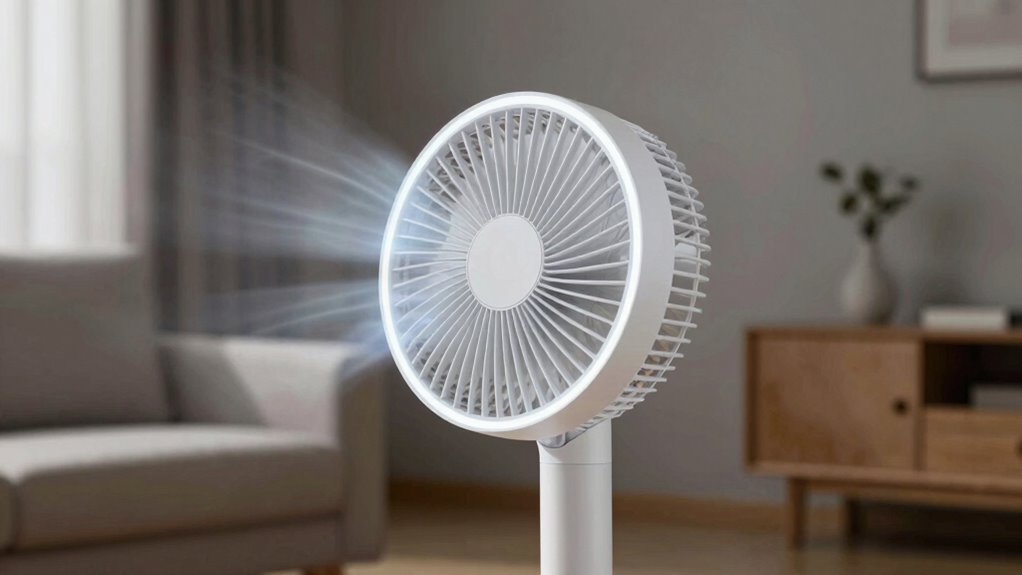
Have you ever wondered if bladeless fans are truly quieter than traditional models? It’s a common question, especially when you’re trying to create a peaceful environment at home or in the office. While many people assume that bladeless fans automatically mean less noise, the reality is a bit more complex. The key lies in understanding how sound frequency and user sensitivity influence noise perception. Bladeless fans generate a different type of sound compared to traditional fans, and this difference can considerably affect how quiet they feel to you.
Traditional fans produce noise primarily from the spinning blades cutting through the air, which creates a broad spectrum of sound frequencies. These sounds tend to include a lot of mid-range and high-frequency noises, which are often more noticeable and potentially more irritating. In contrast, bladeless fans use a different mechanism—air is pushed through a hollow ring, creating a smooth, continuous airflow. This results in a different sound profile, often characterized by a steady, hum-like noise that falls into a lower sound frequency range. Because lower frequencies are generally less intrusive, many users perceive bladeless fans as quieter, even if the actual decibel levels are similar to traditional fans.
Bladeless fans produce a steady, low-frequency hum, making them seem quieter than traditional fans with high-pitched, disruptive sounds.
However, your sensitivity to certain sound frequencies plays a crucial role in how you perceive the noise. Some people are more sensitive to high-frequency sounds, which can make the noise from a traditional fan seem much more disruptive. Others might find the constant hum of a bladeless fan to be less bothersome, especially if it’s at a lower frequency that blends into the background noise. This variation in sensitivity explains why two people can experience the same fan differently—one might find it almost silent, while another finds it disturbingly loud or irritating.
Furthermore, the design and engineering of bladeless fans often help minimize abrupt noise changes. Because they don’t have spinning blades, there’s less mechanical vibration and turbulence, which reduces sudden, sharp sounds that can startle or annoy you. This smoother operation caters to user sensitivity, making the overall noise feel less intrusive even during extended use. The engineering design of bladeless fans plays a significant role in reducing both the intensity and the abruptness of noise, contributing to a more peaceful environment. Additionally, advancements in sound engineering have further optimized these fans to produce more consistent and less disruptive sounds.
In addition, sound frequency and how it interacts with human perception play a central role in the perceived quietness of bladeless fans. In the end, whether a bladeless fan feels quieter depends on a combination of its sound frequency profile and your individual sensitivity. While the technical aspects might suggest they are inherently quieter, your perception is what truly matters. For many, the steady, lower-frequency hum of a bladeless fan creates a more comfortable auditory environment—one that doesn’t just focus on cooling but also on maintaining peace and quiet.
As an affiliate, we earn on qualifying purchases.
Frequently Asked Questions
Do Bladeless Fans Produce Any Noise at All?
Yes, bladeless fans do produce some noise, but it’s usually quieter than traditional fans. You might notice a gentle hum or whooshing sound, which is part of the airflow efficiency they create. Their design also makes maintenance simple, so you can keep them running smoothly without much effort. The noise level is generally minimal, making them ideal if you want effective cooling with less disturbance.
How Do Bladeless Fans Compare to Traditional Fans in Sound Levels?
You’ll notice that bladeless fans are generally quieter than traditional fans, thanks to their sleek design aesthetics and absence of external blades, which reduce mechanical noise. Their energy efficiency also means they operate smoothly with less power, decreasing overall sound levels. You won’t hear loud blades spinning; instead, the gentle hum enhances comfort. This quieter operation makes bladeless fans ideal for bedrooms, offices, or spaces demanding a peaceful environment.
Can Bladeless Fans Help Reduce Overall Noise Pollution?
You can definitely help reduce overall noise pollution by choosing bladeless fans. They operate more quietly than traditional fans, creating less disruption and noise pollution in your environment. Plus, bladeless fans improve air quality by circulating air smoothly, and their energy efficiency means they consume less power, reducing overall noise from electrical sources. When you opt for bladeless, you’re making a smart move towards a quieter, healthier space.
Are Bladeless Fans Quieter in Different Room Sizes?
Yes, bladeless fans tend to be quieter in different room sizes because their sound absorption depends on the space. In larger rooms, the noise disperses more, making the fan seem quieter. Conversely, in smaller rooms, sound waves bounce off walls, amplifying the noise. So, your experience with noise levels varies based on room size and how well the space absorbs sound, impacting overall quietness.
Does the Noise Perception Change Over Time With Bladeless Fans?
Yes, your noise perception can change over time with bladeless fans. As you experience sound adaptation, you might find the noise becomes less noticeable, increasing your noise tolerance. Initially, the fan’s sound may seem loud or distracting, but with continued use, your brain adapts, and the noise feels less intrusive. This natural adjustment helps you enjoy the cooling benefits without being bothered by the fan’s sound for long.
As an affiliate, we earn on qualifying purchases.
Conclusion
You see, bladeless fans don’t just blow air—they whisper comfort into your space, quietly transforming how you perceive noise. Their smooth, steady hum is like a gentle tide, calming your senses and making the sound seem less intrusive. So, while they may not always cool as much as traditional fans, they change your experience by turning noise into a soothing background melody. In this way, they truly redefine what comfort sounds like.
As an affiliate, we earn on qualifying purchases.
As an affiliate, we earn on qualifying purchases.
Fall yard work Picks
leaf blowers
As an affiliate, we earn on qualifying purchases.